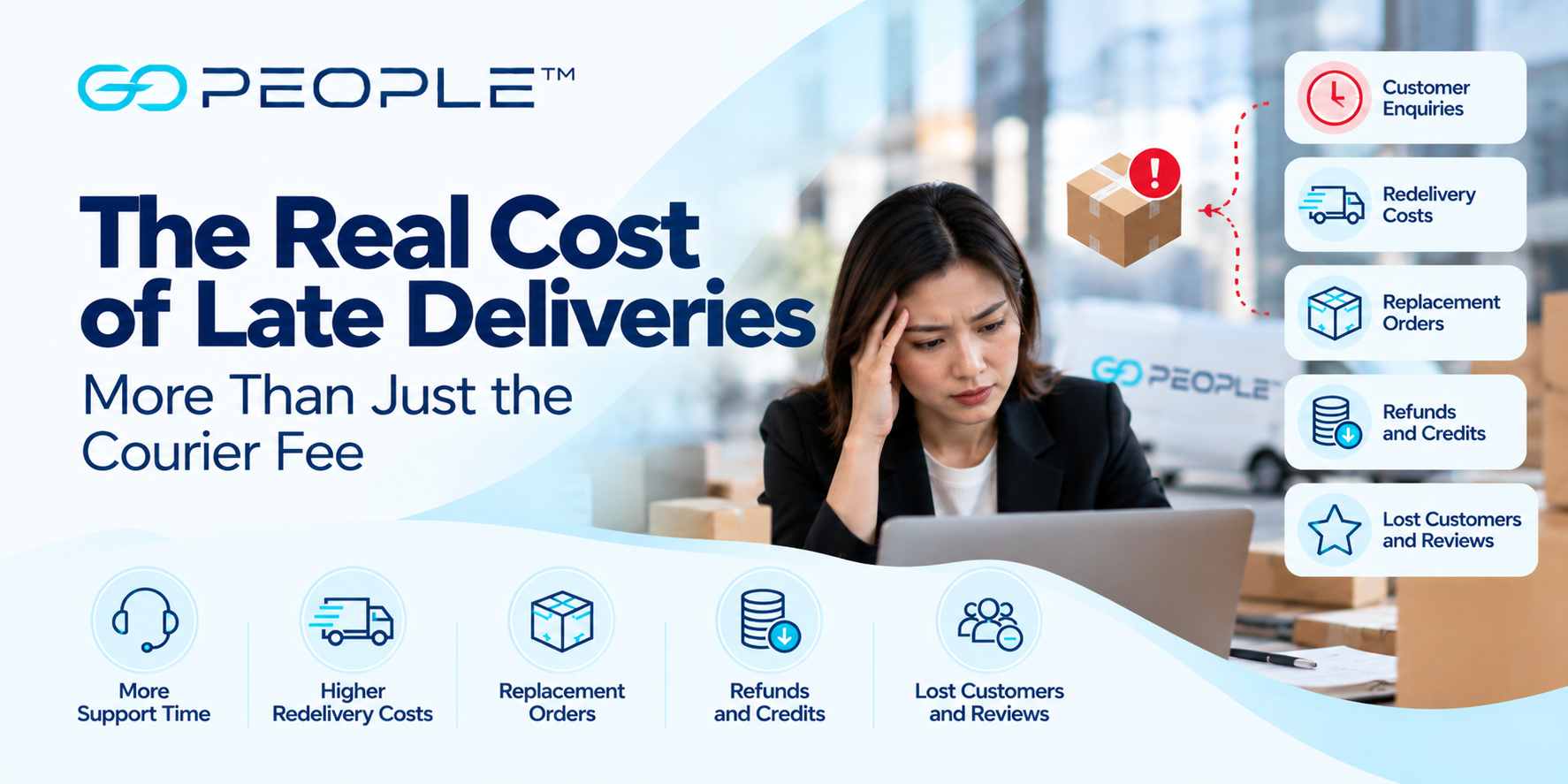
A late delivery costs a business more than the price of the courier.
When an order doesn’t arrive when expected, the consequences can spread across customer service, operations, refunds, redeliveries and customer retention.
For businesses sending deliveries regularly, even a relatively small number of delivery problems can create significant hidden costs.
Understanding those costs is the first step towards reducing them.
1. Customer Service Time
When a delivery is late, one of the first things many customers do is contact the business.
They might ask:
- Where is my order?
- When will it arrive?
- Has it been lost?
- Can you contact the driver?
- Can I get a refund?
- Can you send another one?
Every enquiry takes staff time.
One delayed delivery might only require a few minutes of support. Across hundreds or thousands of deliveries, those minutes can become a significant operational cost.
Better tracking and proactive customer notifications can help reduce some of these enquiries by giving customers visibility without requiring them to contact support.
2. Redelivery Costs
A failed or unsuccessful delivery may require another delivery attempt.
That can mean paying for additional transport and spending more staff time organising the delivery again.
Common causes include:
- incorrect addresses
- incomplete unit numbers
- inaccessible buildings
- unavailable recipients
- unclear delivery instructions
Some failures are unavoidable.
Others can be reduced by improving the quality of delivery information before the order leaves the business.
3. Replacement Orders
When a delivery is significantly delayed or cannot be located, businesses may decide to send a replacement.
That creates costs beyond delivery.
The business may need to absorb:
the product cost + packaging + picking and packing + replacement delivery + customer service time.
If the original order eventually appears as well, recovering it may create another process to manage.
4. Refunds and Credits
Delivery problems can also result in customers asking for refunds, credits or other compensation.
Whether compensation is appropriate depends on the circumstances, but the cost can quickly exceed the original delivery fee.
This is why delivery performance should be considered part of the overall economics of an ecommerce order.
5. Lost Staff Productivity
Delivery problems don’t only affect customer-service teams.
Operations staff may need to:
- search tracking information
- contact the delivery provider
- investigate addresses
- locate proof of delivery
- arrange redelivery
- process refunds
- communicate internally
That is time they aren’t spending on normal business operations.
A delivery system with good tracking and accessible proof of delivery can make exceptions easier to investigate.
6. Customer Confidence
Some of the most important costs are harder to see in an accounting system.
A customer who has a poor delivery experience may be less likely to order again.
For ecommerce businesses in particular, delivery is often one of the final interactions the customer has with the brand.
The retailer may have created the product, website and customer experience, but the delivery still contributes to the customer’s overall impression of the purchase.
7. Negative Reviews
Customers don’t always separate the retailer from the delivery experience.
If an order arrives late or communication is poor, the resulting review may be left against the business that sold the product.
That means delivery performance can affect a brand’s online reputation even when the delivery itself has been outsourced.
8. Inventory and Fulfilment Disruption
Replacement orders and returns can also complicate inventory.
Teams may need to determine:
- whether another product should be dispatched
- whether the original parcel will return
- whether returned stock can be resold
- whether inventory counts need adjustment
What began as one delivery problem can therefore create work across several parts of the business.
The Difference Between a Late Delivery and a Poor Delivery Experience
A delivery being late isn’t always the entire problem.
Sometimes the bigger issue is not knowing what is happening.
Consider two situations.
In the first, a delivery is delayed and the customer receives useful tracking information and updates.
In the second, the delivery is delayed and the customer sees no meaningful tracking update and doesn’t know who to contact.
The physical delay might be similar, but the customer experience can be very different.
This is why tracking and communication matter alongside delivery speed.
How Businesses Can Reduce the Cost of Delivery Problems
No delivery operation can eliminate every exception.
The objective should be to reduce avoidable problems and make unavoidable ones easier to manage.
Improve Address Accuracy
Collect complete delivery details before dispatch.
For businesses processing large numbers of orders, small improvements in address accuracy can prevent repeated failures.
Provide Useful Tracking
Tracking gives businesses and recipients visibility into delivery progress.
It also gives support teams information they can use when investigating an enquiry.
Send Customer Notifications
Relevant delivery updates can help recipients prepare for an arriving order and reduce uncertainty.
Use Proof of Delivery
Proof of delivery gives businesses a record of what happened when a delivery was completed.
This can be particularly valuable when investigating disputes or customer enquiries.
Choose the Appropriate Delivery Service
Don’t use the same delivery model for every order.
GoPeople provides different options for different business requirements:
GoEXPRESS for next-day parcel delivery from customer warehouses in Sydney, Melbourne and Brisbane.
GoBUNDLE for businesses managing multiple deliveries in an optimised delivery run.
GoSAMEDAY for same-day business delivery within supported areas.
GoVIP for urgent on-demand courier requirements.
Businesses can check service availability for their pickup location.
Measure the Cost of Delivery Exceptions
Businesses should consider tracking more than simply their average delivery price.
Useful operational measures can include:
- percentage of deliveries completed successfully
- failed-delivery rate
- redelivery rate
- delivery-related support enquiries
- refunds and replacements caused by delivery problems
- customer complaints
- time spent investigating delivery exceptions
This provides a more complete picture of delivery performance.
A provider that appears cheaper on a rate card may not necessarily produce the lowest overall cost if the business spends significantly more time dealing with problems.
Delivery Cost Is More Than the Courier Fee
The true cost of delivery includes what happens when everything works — and what happens when it doesn’t.
Late and failed deliveries can create customer-service work, redeliveries, replacements, refunds and operational disruption.
For businesses sending significant delivery volumes, improving reliability, visibility and exception management can therefore be just as important as negotiating the lowest possible delivery price.