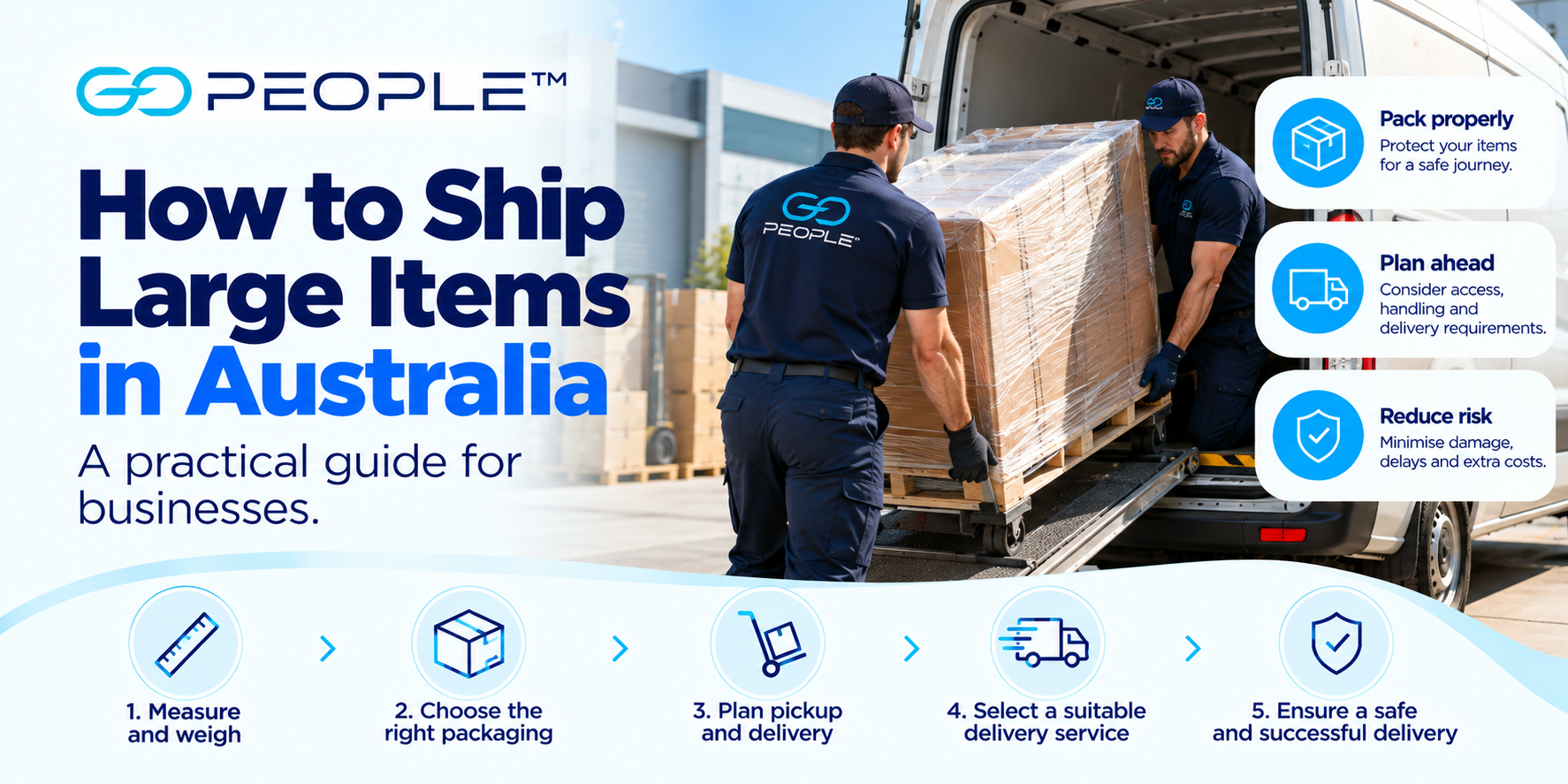
Shipping a small parcel is usually straightforward. Shipping a large, heavy or awkwardly shaped item can be a very different operation.
Furniture, equipment, large retail products, bulky cartons and oversized ecommerce orders may require more careful packaging, handling and delivery planning than standard parcels.
For Australian businesses, the challenge isn’t simply finding someone who can move the item from A to B. You also need to consider whether the item fits the carrier’s size and weight limits, how it will be loaded and unloaded, whether the destination has suitable access, and how the product will be protected throughout the journey.
Getting those details right before booking can reduce delays, damage, failed deliveries and unexpected costs.
This guide explains what businesses should consider when shipping large items in Australia.
What Is Considered a Large Item for Delivery?
There is no single definition of a “large item”.
Every delivery provider may have different restrictions covering:
- maximum weight
- maximum length
- overall dimensions
- cubic volume
- shape
- number of items
- manual-handling requirements
- vehicle requirements
- prohibited or restricted goods
An item that one carrier considers a normal parcel may be oversized for another.
That is why businesses should avoid assuming an item is acceptable simply because it can physically fit inside a vehicle.
Before booking, check the requirements of the particular delivery service.
Start by Measuring and Weighing the Item
Accurate measurements are one of the most important parts of arranging delivery for a large item.
Record the packaged item’s:
Length × Width × Height
You should also know its total packaged weight.
Measure the item after it has been packed, not just the product itself.
Protective packaging can significantly increase its dimensions.
For example, a product measuring:
90 cm × 50 cm × 40 cm
might become:
100 cm × 60 cm × 50 cm
once cushioning and an outer carton have been added.
That difference can affect whether the item is suitable for a particular service.
Understand Actual Weight vs Dimensional Size
Large items aren’t necessarily heavy.
A lightweight but bulky carton can still occupy a significant amount of vehicle capacity.
That is why some delivery and freight services consider both actual weight and the amount of physical space occupied by the shipment.
This is sometimes referred to as volumetric or dimensional weight.
The exact calculation varies between providers, so businesses should check the carrier’s pricing and acceptance rules rather than relying on one universal formula.
For your own operations, however, the principle is simple:
A large lightweight box can create a different delivery requirement from a small box of the same weight.
Knowing both the dimensions and actual weight makes it easier to select an appropriate service.
Choose Packaging That Matches the Product
Large products often require stronger packaging than ordinary ecommerce parcels.
The packaging needs to protect the product against:
- movement
- vibration
- impacts
- compression
- stacking
- loading and unloading
- contact with other items
A carton that is suitable for a small lightweight product may not provide enough structural strength for something significantly larger.
Depending on the item, packaging might include:
- heavy-duty corrugated cartons
- internal dividers
- foam protection
- corner protectors
- protective wrapping
- reinforced tape
- straps
- pallets
- custom packaging
The objective is not simply to put a box around the product.
The packaging should protect it through the entire delivery journey.
Avoid Oversized Packaging
More packaging isn’t always better.
Using a carton substantially larger than the product can create several problems.
The product may move inside the carton, increasing the risk of damage. The shipment also takes up more vehicle and warehouse space than necessary.
Oversized packaging can also increase the shipment’s dimensional size.
Use enough space for appropriate protection, but avoid unnecessary empty volume.
This principle also supports more efficient packaging generally. Our guide to eco-friendly ecommerce packaging discusses right-sized packaging in more detail.
Prevent Movement Inside the Package
A large product shouldn’t be able to move freely inside its packaging.
Movement can result in the item striking:
- carton walls
- other components
- internal fittings
- protective materials
Fill empty spaces where appropriate and protect vulnerable areas.
For products with multiple components, consider whether parts should be individually wrapped or separated.
After packing, carefully check whether the product can shift significantly inside the package.
If it can, additional internal protection may be needed.
Protect Corners and Edges
Corners and edges are particularly vulnerable during handling.
This matters for products such as:
- furniture
- mirrors
- framed products
- electronics
- cabinetry
- flat-packed goods
- large retail products
Corner protectors, edge protection and suitable cushioning can help prevent relatively minor impacts from damaging the product itself.
The appropriate packaging will depend on the product.
Consider Whether the Item Should Be Palletised
Some large or heavy shipments may be better suited to palletised freight rather than ordinary parcel or courier delivery.
Palletisation can make sense when:
- an item is particularly heavy
- multiple cartons are moving together
- goods require forklift handling
- cartons need additional stability
- the shipment is designed for freight networks
However, pallet delivery introduces its own requirements.
Both pickup and destination locations may need appropriate loading access, equipment and space.
A pallet should therefore not automatically be treated as a standard courier shipment.
If the shipment requires specialist freight equipment, use a provider designed for that type of movement.
Think About Manual Handling Before Booking
Large-item delivery is also a workplace safety issue.
Ask:
Can one person safely lift and carry this item?
If not, the delivery may require:
- two-person handling
- a trolley
- forklift equipment
- a tail-lift vehicle
- loading-dock access
- specialist equipment
Don’t assume the driver will have additional people or equipment available unless that is explicitly included in the service.
Businesses should provide accurate information about large or heavy goods before booking so that an appropriate delivery method can be selected.
Plan the Pickup
The pickup location can make a major difference to the delivery.
Before the driver arrives, consider:
- Where is the item stored?
- Can the vehicle reach the loading area?
- Is there a loading dock?
- Are there stairs?
- Is a lift available?
- Are there height restrictions?
- Is the item ready for collection?
- Does loading require special equipment?
- Will warehouse staff assist with loading?
A driver arriving at a warehouse to find an unexpectedly large item in an inaccessible location can create unnecessary delays.
The delivery provider should know relevant pickup requirements in advance.
Plan the Destination Too
Businesses sometimes focus heavily on pickup and overlook the delivery address.
A large product may be easy to collect from a warehouse but difficult to deliver to:
- an apartment
- a shopping centre
- an office tower
- a construction site
- a hospital
- a school
- a property with restricted access
Before dispatch, collect enough information to understand the destination.
Useful details can include:
- unit or suite number
- loading-dock instructions
- building access
- recipient contact number
- business opening hours
- delivery restrictions
- parking limitations
- floor or lift requirements
- special receiving instructions
This information should be provided through the appropriate delivery-instruction process.
Don’t Assume Door-to-Door Means Room-to-Room
This is particularly important for bulky products.
A delivery to an address does not necessarily include carrying a large product:
- upstairs
- through a building
- into a particular room
- assembling the item
- removing old products
- removing packaging
Those are additional services that may require specialist providers.
Businesses should understand exactly what the chosen delivery service includes and communicate that clearly to customers.
Use Clear Labels
Labels won’t compensate for inadequate packaging, but clear shipment information is still important.
Ensure the delivery label is:
- securely attached
- easy to read
- not placed across an opening
- protected from becoming detached
- matched to the correct shipment
If the item consists of multiple pieces, make sure the relationship between those pieces is clear.
For example:
1 of 3
2 of 3
3 of 3
Where applicable, handling information should also be clear.
Photograph High-Value or Unusual Items Before Dispatch
For higher-value or unusual shipments, businesses may benefit from maintaining a record of the product and packaging before collection.
For example, photographs can show:
- product condition
- packaging condition
- how the item was protected
- how multiple pieces were packed
This can help internal investigation if there is later a dispute about when damage occurred.
Businesses should also understand the carrier’s applicable terms, liability arrangements and claims process before sending valuable goods.
Choose the Right Vehicle and Delivery Service
Not every large item belongs in the same type of vehicle.
The appropriate delivery method depends on factors including:
- dimensions
- weight
- quantity
- destination
- urgency
- loading requirements
- unloading requirements
- service availability
A large lightweight carton may have very different requirements from a 100 kg piece of equipment.
Similarly, twenty large cartons leaving one warehouse create a different operational problem from one urgent item.
The service should fit the shipment—not the other way around.
Large Items and Multi-Drop Delivery
Businesses sometimes need to deliver larger products to multiple customers from the same warehouse.
Where the items are suitable for the service, grouping multiple deliveries into a planned run can be more efficient than arranging each address separately.
GoBUNDLE is GoPeople’s multi-drop delivery service and includes route optimisation.
This can be relevant to businesses that have multiple eligible deliveries leaving from the same pickup location.
However, businesses should confirm that the size, weight and handling requirements of their goods are appropriate for the service before booking.
Large Items That Need Same-Day Delivery
Some larger products may need to reach customers on the same day.
If the shipment falls within the applicable requirements and service area, GoSAMEDAY may be an option.
Again, urgency doesn’t override size, weight or handling restrictions.
An item must still be appropriate for the delivery service being booked.
Urgent Large-Item Delivery
An urgent item may sometimes be suitable for an on-demand courier.
GoVIP is GoPeople’s on-demand courier service.
Whether it is appropriate depends on the particular shipment and service requirements.
If an item requires specialist equipment, heavy freight handling or a vehicle outside the available service, businesses should use an appropriate specialist provider instead.
What About Next-Day Delivery?
For eligible business parcel volumes in Sydney, Melbourne and Brisbane, GoEXPRESS provides next-day delivery.
Businesses should confirm applicable parcel specifications before treating a large item as suitable for a parcel delivery network.
Large freight and specialist bulky goods shouldn’t be presented as ordinary parcels simply to fit a particular service.
Large Items May Need Specialist Freight
This is an important distinction.
Some products are simply too large, heavy or specialised for a standard courier service.
Examples might include shipments requiring:
- cranes
- specialist lifting equipment
- specialist heavy vehicles
- forklift-only handling
- temperature-controlled freight
- dangerous-goods transport
- specialist furniture handling
- installation services
In those situations, a specialist freight or transport provider may be more appropriate.
The safest approach is to give the carrier accurate dimensions, weight and handling requirements before booking.
How to Reduce Damage When Shipping Large Items
There is rarely one single cause of delivery damage.
Businesses should look at the complete journey.
Before Pickup
Check that:
- the product is properly packed
- empty space is controlled
- vulnerable areas are protected
- the carton is structurally suitable
- labels are secure
- dimensions and weight are accurate
During Loading
Consider:
- whether the item can be safely lifted
- whether it can move inside the vehicle
- whether other goods can damage it
- whether heavy items could crush lighter products
During Delivery
Make sure:
- the destination information is accurate
- access requirements are known
- the recipient can accept the item where required
- appropriate delivery instructions have been supplied
Businesses sending delicate products should also see our guide to packing and delivering fragile items safely.
How Much Does It Cost to Ship a Large Item?
There is no useful single answer because large-item delivery costs can depend on many variables.
These may include:
- distance
- dimensions
- weight
- number of items
- vehicle requirements
- delivery urgency
- pickup accessibility
- destination accessibility
- manual-handling requirements
- geographic coverage
The cheapest quoted delivery isn’t necessarily the lowest-cost option overall.
Damage, failed delivery attempts, additional handling and operational delays can all add cost.
Businesses should consider the total delivery cost, not simply the initial transport price.
Our guide to reducing delivery costs explores this in more detail.
Build Large-Item Delivery Into Your Ecommerce Process
If large products are a regular part of your ecommerce operation, don’t treat delivery as an exception every time an order arrives.
Document the process.
For each product or product category, consider maintaining:
- packaged dimensions
- packaged weight
- packaging method
- handling requirements
- suitable delivery services
- unsuitable delivery services
- destination restrictions
- customer instructions
This allows your team to make more consistent delivery decisions.
It can also help prevent someone from accidentally booking a large product into an unsuitable service.
Set Customer Expectations Before Checkout
Customers purchasing large products should understand how delivery works before completing the order.
Depending on your operation, useful information could include:
- expected delivery timeframe
- delivery area
- whether someone needs to be present
- where the item will be delivered
- access requirements
- what isn’t included
- how tracking works
- what happens after an unsuccessful delivery attempt
Clear expectations can prevent a customer from assuming a standard delivery includes services such as installation or carrying an item upstairs.
Track Delivery Performance
Businesses regularly shipping larger products should monitor what happens after dispatch.
Useful measures include:
- successful first-attempt delivery rate
- damage rate
- failed deliveries
- redeliveries
- customer complaints
- delivery cost per order
- delivery time
- common access problems
Patterns can reveal operational problems.
For example, repeated damage to one product might indicate a packaging issue rather than a courier issue.
Repeated failed deliveries to apartments might suggest that better access information needs to be collected during checkout.
Delivery data should be used to improve the process.
A Large-Item Delivery Checklist
Before sending a large item, ask:
Product
- What are the packaged dimensions?
- What is the packaged weight?
- Is it fragile or unusually shaped?
Packaging
- Is the outer packaging strong enough?
- Is internal movement controlled?
- Are corners and vulnerable areas protected?
Handling
- Can one person safely handle it?
- Is special equipment required?
- Does it need palletisation?
Pickup
- Can the vehicle access the collection point?
- Is the item ready?
- Are there loading restrictions?
Delivery
- Is the address complete?
- Are there stairs, lifts or loading docks?
- Does the recipient need to be present?
- Are there restricted delivery hours?
Service
- Does the item meet the carrier’s requirements?
- Is the vehicle appropriate?
- Is the selected service suitable for the urgency?
If you can’t confidently answer those questions, clarify them before dispatch.
Frequently Asked Questions About Shipping Large Items
What is considered a large parcel in Australia?
There is no universal definition.
Carriers have their own maximum dimensions, weights and acceptance requirements. Check the specifications of the particular delivery service before booking.
How do I calculate the size of a large shipment?
Measure the item after packaging and record its length, width and height.
You should also know its total packaged weight.
Some carriers may use dimensional or volumetric calculations when determining pricing or eligibility.
How should I package a large item for delivery?
Use packaging appropriate to the item’s weight, shape and fragility. This may include a strong outer carton, internal cushioning, corner protection, dividers, reinforced tape or other protective materials.
The item shouldn’t be able to move excessively inside the package.
Should heavy items be placed on pallets?
Sometimes.
Pallets can be suitable for heavy goods or multiple cartons, but palletised freight may require specialist vehicles, forklifts or loading facilities.
Check with the delivery provider before booking.
Can a courier deliver furniture and other bulky items?
It depends on the courier, vehicle and item.
Some larger items may be suitable for courier delivery, while furniture or very bulky products may require specialist transport or two-person handling.
Provide accurate dimensions, weight and handling requirements before booking.
How can businesses reduce damage to large items?
Start with appropriate packaging, minimise movement inside the package, protect vulnerable areas and make sure the product can be safely loaded and transported.
Businesses should also review damage patterns to identify recurring packaging or handling problems.
Can GoPeople deliver large items?
Suitability depends on the particular item’s dimensions, weight, handling requirements, location and the GoPeople service being considered.
Businesses should check service availability and applicable requirements before booking rather than assuming an oversized or heavy item is suitable.
You can check GoPeople delivery service availability here.
Better Large-Item Delivery Starts Before the Driver Arrives
Successful delivery of a large item begins long before collection.
Accurate measurements, suitable packaging, safe handling, appropriate vehicle selection and complete delivery information all matter.
For businesses regularly shipping large products, these steps should become part of the fulfilment process rather than being handled differently for every order.
Most importantly, don’t force an item into an unsuitable delivery service.
Match the service to the shipment’s actual size, weight, handling requirements and urgency.
That approach can reduce damage, avoid failed deliveries and create a more reliable experience for both your business and your customers.