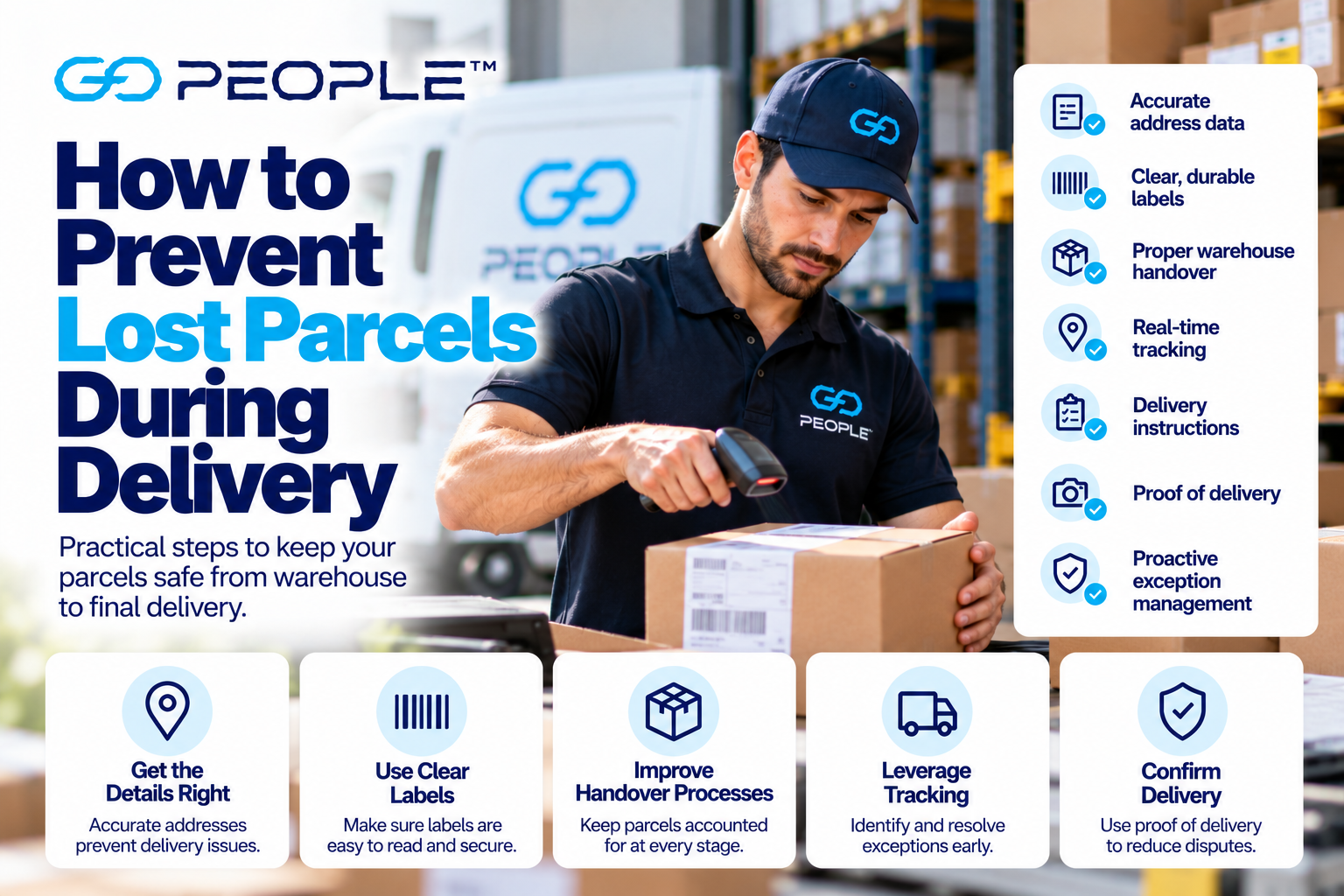
Lost parcels are expensive.
The direct cost of the product is only part of the problem. A missing parcel can also create:
- replacement costs;
- additional delivery charges;
- customer-service work;
- refunds or credits;
- investigation time;
- inventory discrepancies;
- customer frustration; and
- disputes over whether delivery actually occurred.
For businesses sending significant parcel volumes, even a relatively small loss rate can create meaningful operational cost.
The best approach is therefore not simply knowing what to do after a parcel disappears.
It is building a delivery process that makes parcels less likely to go missing in the first place.
That requires looking at the entire journey:
Warehouse → Handover → Transport → Delivery → Proof of Delivery
Every handover is an opportunity for information or physical goods to become disconnected.
Here is how businesses can reduce that risk.
What Does a “Lost Parcel” Actually Mean?
A parcel reported as lost is not necessarily physically lost.
It may be:
- incorrectly labelled;
- assigned to the wrong order;
- left in the warehouse;
- collected but not correctly recorded;
- sorted incorrectly;
- sent to the wrong location;
- delivered to the wrong address;
- left somewhere the recipient cannot find;
- accepted by another person;
- delayed without a recent tracking update; or
- genuinely missing.
That distinction matters because different problems require different prevention strategies.
If parcels repeatedly disappear before pickup, improving final-delivery tracking will not solve the problem.
Businesses need to identify where in the delivery journey losses or discrepancies occur.
1. Start With Accurate Order Data
Parcel loss prevention begins before the parcel is packed.
Incorrect customer information can send a perfectly handled parcel to the wrong place.
Important information includes:
- recipient name;
- street address;
- suburb;
- state;
- postcode;
- apartment or unit number;
- business name where relevant;
- mobile number;
- email address; and
- useful delivery instructions.
Address data should be captured as accurately as possible when the customer places the order.
2. Validate Addresses Before Dispatch
Simple address mistakes can create major delivery problems.
Common examples include:
- wrong postcode;
- missing unit number;
- incorrect suburb;
- duplicated street information;
- typo in the street number;
- old customer address; and
- business name without enough location information.
Where appropriate, businesses can use address-validation tools during checkout or fulfilment.
Orders with suspicious or incomplete addresses can be flagged before dispatch.
Fixing an address while the parcel is still in the warehouse is much easier than fixing it after the parcel has entered the delivery network.
3. Make Labels Easy to Read
A damaged or unreadable label can separate the physical parcel from its digital delivery record.
Labels should generally be:
- clearly printed;
- securely attached;
- positioned on a flat surface;
- unobstructed by tape;
- protected from foreseeable damage; and
- associated with the correct parcel.
Avoid placing important labels across:
- box seams;
- corners;
- openings; or
- surfaces likely to become damaged.
The label needs to remain usable throughout the delivery journey.
4. Remove Old Labels When Reusing Packaging
Reusing suitable packaging can reduce waste.
But old shipping labels can create confusion.
A box containing:
- an old barcode;
- an old recipient address;
- a new barcode; and
- a new delivery address
creates unnecessary ambiguity.
If packaging is reused, remove or completely cover irrelevant old shipping information before attaching the new label.
There should be no doubt which information applies to the current shipment.
5. Match the Correct Label to the Correct Parcel
A perfectly printed label is useless if it is attached to the wrong order.
This can happen in busy fulfilment operations where many similar parcels are being packed simultaneously.
Consider controls such as:
Order → Pick → Verify → Pack → Label → Dispatch
Depending on the operation, barcode scanning or another verification process may help confirm that:
- the correct product;
- the correct parcel; and
- the correct delivery label
remain associated.
This is particularly important as daily volume increases.
6. Give Every Parcel a Unique Reference
Businesses should be able to distinguish one parcel from another.
A unique reference can connect:
- customer order;
- parcel;
- delivery booking;
- tracking record; and
- proof of delivery.
This becomes particularly important when one customer order contains multiple parcels.
For example:
Order #12345
may contain:
- Parcel 1 of 3;
- Parcel 2 of 3;
- Parcel 3 of 3.
If only two arrive, the business needs to know exactly which parcel is missing.
7. Control the Dispatch Area
A poorly organised dispatch area increases the risk of parcels being:
- left behind;
- collected by the wrong driver;
- mixed between services;
- counted incorrectly; or
- dispatched on the wrong route.
Create clearly defined staging areas.
For example:
Ready for GoEXPRESS
Ready for GoBUNDLE
Urgent / On-Demand
Not Ready for Dispatch
The exact structure depends on your operation.
The objective is to make parcel status physically obvious.
8. Separate “Ready” From “Not Ready”
One common source of errors is mixing completed orders with parcels still being processed.
A driver should not need to determine whether each box on a warehouse floor is ready for collection.
A clear dispatch process should answer:
- Which parcels are ready?
- Which service are they using?
- How many are being collected?
- Who is collecting them?
- Has the handover occurred?
Reducing ambiguity reduces errors.
9. Count Parcels at Handover
Suppose your system says:
247 parcels ready
but the driver collects:
246 parcels
One parcel is already unaccounted for before the vehicle leaves.
If nobody notices, the discrepancy may not become apparent until a customer complains days later.
A basic handover reconciliation can help identify differences earlier.
Depending on the operation, this might involve:
- parcel count;
- manifest;
- scan;
- cage count;
- route allocation; or
- another suitable verification process.
The principle is simple:
Know what was supposed to leave and what actually left.
10. Create a Clear Handover Record
When custody changes, the business should ideally have enough information to understand what happened.
Useful records may include:
- date;
- time;
- pickup location;
- shipment reference;
- parcel count; and
- collection status.
The appropriate level of detail depends on the delivery model and volume.
A business sending five high-value parcels may need a different process from a warehouse sending thousands of routine ecommerce parcels.
11. Understand Chain of Custody
Chain of custody means being able to understand how an item moved through different stages and handovers.
For parcel delivery, that could include:
Packed
↓
Ready for dispatch
↓
Collected
↓
Processed
↓
Out for delivery
↓
Delivered
The more significant the parcel, the more important it may be to know when responsibility changed.
A clear chain of custody helps answer a crucial question during an investigation:
Where was the parcel last reliably accounted for?
12. Use Tracking as an Operational Tool
Tracking is not only for customers.
Businesses can use tracking to identify exceptions.
For example, if 500 parcels were collected yesterday but only 499 show the expected next status, that missing event may be worth investigating.
Without visibility, the first warning may come from a customer several days later.
Tracking can therefore support proactive exception management.
13. Know What Tracking Can and Cannot Tell You
Tracking provides information about recorded delivery events.
It does not necessarily provide continuous physical visibility of every parcel at every second.
Businesses should avoid assuming:
“There hasn’t been an update, therefore the parcel is definitely lost.”
A missing tracking event may mean:
- processing delay;
- delayed status update;
- operational exception; or
- another issue requiring investigation.
The correct response is to investigate based on the available delivery record.
For customer-facing guidance, see How to Track Your Delivery in Real Time.
14. Detect Exceptions Early
The longer a parcel discrepancy remains unnoticed, the harder it can become to investigate.
Businesses can establish exception rules.
Examples might include:
- collected parcel has no subsequent expected status;
- delivery is materially outside its expected timeframe;
- delivery attempt failed;
- address problem identified;
- parcel returned unexpectedly; or
- delivery marked complete but customer disputes receipt.
The appropriate thresholds depend on the delivery service.
The principle is:
Don’t wait for every problem to become a customer complaint.
15. Maintain Accurate Customer Contact Information
Drivers and support teams may need to contact the recipient.
An incorrect mobile number can make a manageable delivery problem much harder to resolve.
For example:
Driver cannot access apartment building.
Correct number:
Recipient answers → access provided → delivery completed
Incorrect number:
No contact → unsuccessful delivery → parcel requires further handling
Contact information therefore contributes to successful delivery.
16. Collect Useful Delivery Instructions
Good delivery instructions can reduce ambiguity at the destination.
Depending on the service and delivery requirements, useful information might include:
- apartment/unit number;
- building entrance;
- reception location;
- loading dock;
- concierge instructions;
- business opening hours; or
- other relevant access details.
Avoid relying on vague instructions such as:
“Leave somewhere safe.”
Useful instructions should help the delivery process while remaining consistent with the applicable delivery service and authority-to-leave arrangements.
17. Pay Particular Attention to Apartments
Apartment deliveries can be more complicated than houses.
Potential issues include:
- locked entrances;
- intercom systems;
- multiple buildings;
- incorrect unit numbers;
- inaccessible mailrooms;
- concierge procedures;
- lifts; and
- difficulty contacting recipients.
Businesses should capture complete address and access information before dispatch wherever possible.
A parcel delivered to the correct street but wrong building or unit can quickly become a missing-parcel complaint.
18. Business Addresses Have Their Own Risks
Commercial addresses can also create ambiguity.
A large office complex may contain:
- multiple businesses;
- several entrances;
- loading docks;
- reception desks;
- different floors; and
- security procedures.
Useful information can include:
Company name + recipient + street address + floor/unit + contact number
The more complex the destination, the more important accurate information becomes.
19. Be Careful With Unattended Delivery
Where unattended delivery is permitted under the relevant service and customer authority, location matters.
A parcel left:
- exposed to the street;
- in a highly visible area;
- outside the wrong unit; or
- somewhere the customer cannot identify
can result in theft, weather damage or a missing-parcel report.
Delivery providers and businesses should follow the applicable authority-to-leave and delivery requirements.
For higher-risk orders, a different handover method may be more appropriate.
20. Proof of Delivery Reduces Ambiguity
Proof of delivery helps establish that a delivery event occurred.
Depending on the service, proof of delivery may include information such as:
- completion status;
- delivery timestamp;
- photograph;
- signature; or
- other delivery records.
The exact information available depends on the service.
Proof of delivery is particularly useful when a customer says:
“My order says delivered, but I can’t find it.”
It gives support teams something concrete to investigate.
See What Is Proof of Delivery and Why Does It Matter? for more detail.
21. “Delivered” Does Not Always End the Investigation
A parcel marked delivered can still become the subject of a customer enquiry.
Possible scenarios include:
- wrong address;
- wrong unit;
- accepted by another person;
- left in an unexpected location;
- customer cannot identify the location;
- theft after delivery; or
- delivery record requiring clarification.
Businesses should have a defined process for these enquiries rather than automatically treating a delivered status as the end of the matter.
22. Build a Missing-Parcel Investigation Process
When a parcel is reported missing, support staff should know what to check.
A practical process may include:
- confirm the tracking/reference number;
- verify the delivery address;
- review tracking events;
- review proof of delivery where available;
- confirm relevant timestamps;
- check delivery instructions;
- determine the last confirmed stage;
- escalate through the appropriate process; and
- update the customer.
A consistent process improves both efficiency and investigation quality.
For recipient guidance, see What to Do When Your Package Goes Missing.
23. Don’t Create Multiple Investigations for the Same Parcel
Poor internal coordination can make missing-parcel cases harder to resolve.
For example:
- customer contacts support;
- warehouse creates another enquiry;
- sales representative separately contacts the provider;
- another employee opens a third case.
Now several people are investigating the same parcel with different information.
Use the parcel reference to maintain a single clear investigation trail wherever possible.
24. Record Investigation Outcomes
Don’t simply close a missing-parcel case.
Record what happened.
Possible categories might include:
- address error;
- warehouse dispatch discrepancy;
- delivery exception;
- wrong-address delivery;
- unattended-delivery issue;
- recipient located parcel;
- delayed parcel;
- returned parcel; or
- unable to locate.
Over time, this creates useful operational data.
25. Look for Patterns, Not Just Individual Incidents
Suppose a business has 50 missing-parcel complaints in a quarter.
Looking at them individually may not reveal much.
Categorising them might show:
- 18 incorrect addresses;
- 12 apartment access issues;
- 8 warehouse dispatch errors;
- 6 customers later found the parcel;
- 4 wrong-address deliveries;
- 2 unresolved.
Now the business knows where to focus.
Instead of vaguely trying to “reduce lost parcels”, it can target the largest causes.
26. Measure Your Parcel Loss Rate
A simple metric is:
Lost or unresolved parcels ÷ total parcels sent × 100
For example:
10 unresolved parcels ÷ 10,000 deliveries = 0.1%
The number alone is not enough.
Track it over time and segment it by:
- warehouse;
- delivery service;
- destination type;
- customer type;
- product;
- delivery area; and
- cause.
This can reveal operational patterns.
27. Measure Missing-Parcel Enquiries Separately
Not every missing-parcel enquiry represents a genuinely lost parcel.
A useful reporting structure might distinguish:
Missing-Parcel Enquiry Rate
How many customers report they cannot find a parcel?
Confirmed Loss Rate
How many parcels are ultimately determined to be lost?
Wrong-Address Rate
How many are delivered incorrectly?
Customer-Located Rate
How many customers later find the parcel?
Resolution Time
How long does the average investigation take?
This provides a much more accurate picture than treating every enquiry as a confirmed loss.
28. Calculate the True Cost of Parcel Loss
Suppose a product costs the business $40.
If it goes missing, the cost may not simply be $40.
Potential additional costs include:
- replacement product;
- packing;
- replacement delivery;
- support time;
- investigation time;
- refund;
- goodwill credit; and
- customer dissatisfaction.
A useful formula is:
**Product cost
- fulfilment cost
- delivery/replacement cost
- support cost
- compensation
= direct loss cost**
There may also be a longer-term customer impact.
This is why reducing loss can justify investment in better processes and technology.
29. Higher-Value Goods May Need Additional Controls
Not every parcel requires the same risk controls.
Businesses sending higher-value products may consider whether additional processes are appropriate.
Depending on the goods and service, that could include:
- additional verification;
- stronger packaging;
- signature requirements where available and appropriate;
- more restrictive delivery instructions;
- additional internal handover controls; or
- different delivery arrangements.
The appropriate approach depends on the product and delivery service.
Avoid using a routine parcel process for goods that require specialist transport or handling.
30. Packaging Helps Keep Parcels Identifiable
Packaging is usually discussed in terms of preventing physical damage.
It can also affect parcel identification.
Packaging should be strong enough that:
- the box remains intact;
- the label stays attached;
- contents do not escape;
- seams remain closed; and
- handling does not destroy important shipping information.
A box that breaks open can become both a damage problem and an identification problem.
31. Avoid Overstuffed or Poorly Sealed Parcels
An overloaded box may:
- split;
- distort;
- open;
- damage the label; or
- lose contents.
Use packaging appropriate to:
- product size;
- weight;
- fragility; and
- expected handling.
For fragile products, see How to Pack and Deliver Fragile Items Safely.
32. Train Warehouse Teams on Dispatch Accuracy
Technology alone will not prevent parcel loss.
People need clear processes.
Warehouse training should cover relevant procedures such as:
- correct labelling;
- parcel verification;
- dispatch staging;
- handover;
- exception handling; and
- what to do when counts do not reconcile.
The goal is consistency.
If five warehouse employees use five different dispatch processes, errors become harder to prevent and investigate.
33. Reduce Manual Re-Entry of Information
Every time someone manually copies information from one system to another, there is an opportunity for error.
Where practical, integrations can reduce repetitive data entry between:
- ecommerce platform;
- order management;
- warehouse systems; and
- delivery booking.
The exact technology depends on the business.
The principle is to minimise unnecessary transcription of critical delivery information.
34. Use Clear Delivery Statuses
Ambiguous statuses create confusion.
Operations and support teams should understand what common delivery statuses mean and what should happen next.
For example:
Booked
does not necessarily mean:
Collected
And:
Out for delivery
does not mean:
Delivered
Clear status definitions help teams identify where a parcel actually is in the process.
35. Don’t Ignore Stalled Tracking
A parcel that has not progressed as expected may need attention.
That does not automatically mean it is lost.
But it may be an exception.
Businesses handling significant parcel volumes can benefit from identifying shipments that fall outside expected patterns.
Early investigation can sometimes resolve a problem before the customer contacts support.
36. Keep Customer Communication Clear
If a parcel is genuinely being investigated, tell the customer what is happening without making unsupported promises.
Useful communication should explain:
- that the issue is being reviewed;
- what information is needed;
- what the next step is; and
- when the customer should expect another update where appropriate.
Avoid guessing about where the parcel is.
Accurate information builds more trust than confident speculation.
37. Reduce Failed Deliveries
Failed deliveries increase the number of times a parcel needs to be handled.
Each additional handling step creates more complexity.
Reducing unsuccessful attempts can therefore contribute to a more controlled delivery process.
Common preventative measures include:
- accurate addresses;
- correct contact details;
- clear instructions;
- appropriate delivery options;
- customer notifications; and
- useful tracking.
See How to Reduce Failed Deliveries and Improve First-Attempt Delivery Success.
38. Choose the Right Delivery Model
Different delivery requirements suit different services.
Regular Business Parcels
For eligible businesses sending parcel volume from Sydney, Melbourne or Brisbane, GoEXPRESS provides next-day delivery with tracking and proof of delivery.
Multiple Local Deliveries
For businesses sending multiple deliveries from a pickup location, GoBUNDLE provides multi-drop delivery with route optimisation, tracking and digital proof of delivery.
Same-Day Requirements
GoSAMEDAY provides same-day delivery for eligible business pickups.
Urgent Individual Deliveries
GoVIP provides an on-demand option for urgent and time-sensitive deliveries.
The objective is to match the delivery model to the actual requirement rather than forcing every parcel into the same process.
39. Evaluate Delivery Providers on Visibility
When comparing delivery providers, don’t consider only price.
Ask:
- Is tracking available?
- What delivery events are visible?
- Is proof of delivery available?
- How are exceptions handled?
- What happens after a failed delivery?
- How are missing parcels investigated?
- What support is available?
- Can the business access useful delivery records?
Visibility becomes especially important when something goes wrong.
For a broader evaluation framework, see How to Choose a Courier Service for Your Business.
40. Create a Parcel-Loss Prevention Checklist
A practical process might look like this:
Before Packing
- Verify customer details.
- Check address completeness.
- Flag unusual information.
During Packing
- Use appropriate packaging.
- Match products to orders.
- Remove old shipping labels.
Labelling
- Print clearly.
- Attach securely.
- Verify parcel and label match.
Dispatch
- Move parcel to correct staging area.
- Confirm service.
- Reconcile parcel counts.
Handover
- Record collection.
- Confirm expected parcel quantity.
- Investigate discrepancies immediately.
In Transit
- Monitor delivery statuses.
- Identify exceptions.
Final Delivery
- Use appropriate delivery instructions.
- Maintain proof of delivery where provided.
After an Issue
- Review the delivery record.
- Investigate consistently.
- Record the root cause.
- Use the result to improve the process.
The Best Time to Prevent a Lost Parcel Is Before It Goes Missing
Missing-parcel investigations will always be necessary from time to time.
But prevention is more efficient than recovery.
A strong parcel-loss prevention process combines:
accurate data
correct labels
controlled warehouse processes
clear handovers
tracking
proof of delivery
exception management
root-cause analysis
No individual measure eliminates every risk.
Together, however, they make it much easier to know:
- what was sent;
- where it was going;
- when it changed hands;
- what happened during delivery; and
- where to investigate if something goes wrong.
That visibility is the foundation of a more reliable parcel-delivery operation.
Frequently Asked Questions
How can businesses prevent parcels from getting lost?
Start with accurate addresses, clear labels, controlled dispatch processes, parcel reconciliation, reliable tracking, useful delivery instructions and proof of delivery. Businesses should also investigate recurring incidents to identify their root causes.
Why do parcels go missing during delivery?
A missing parcel can result from incorrect addresses, labelling errors, warehouse dispatch mistakes, sorting issues, delivery to the wrong location, access problems or other operational exceptions. Not every parcel reported missing is permanently lost.
How does tracking help prevent lost parcels?
Tracking creates visibility into recorded delivery events. Businesses can use it to identify parcels that are not progressing as expected and investigate exceptions earlier.
What is proof of delivery?
Proof of delivery is a record associated with delivery completion. Depending on the service, it may include information such as a timestamp, photograph, signature or other delivery details.
What should a business do when a customer says a parcel is missing?
Verify the address and tracking reference, review tracking events and available proof of delivery, check delivery instructions and follow the appropriate investigation process.
Should high-value parcels use a different delivery process?
Potentially. Businesses should assess the value and risk of the goods and determine whether additional verification, handover controls or another suitable delivery arrangement is appropriate.
What parcel-loss metrics should businesses track?
Useful measures include missing-parcel enquiry rate, confirmed loss rate, wrong-address incidents, resolution time and the root causes of reported losses.