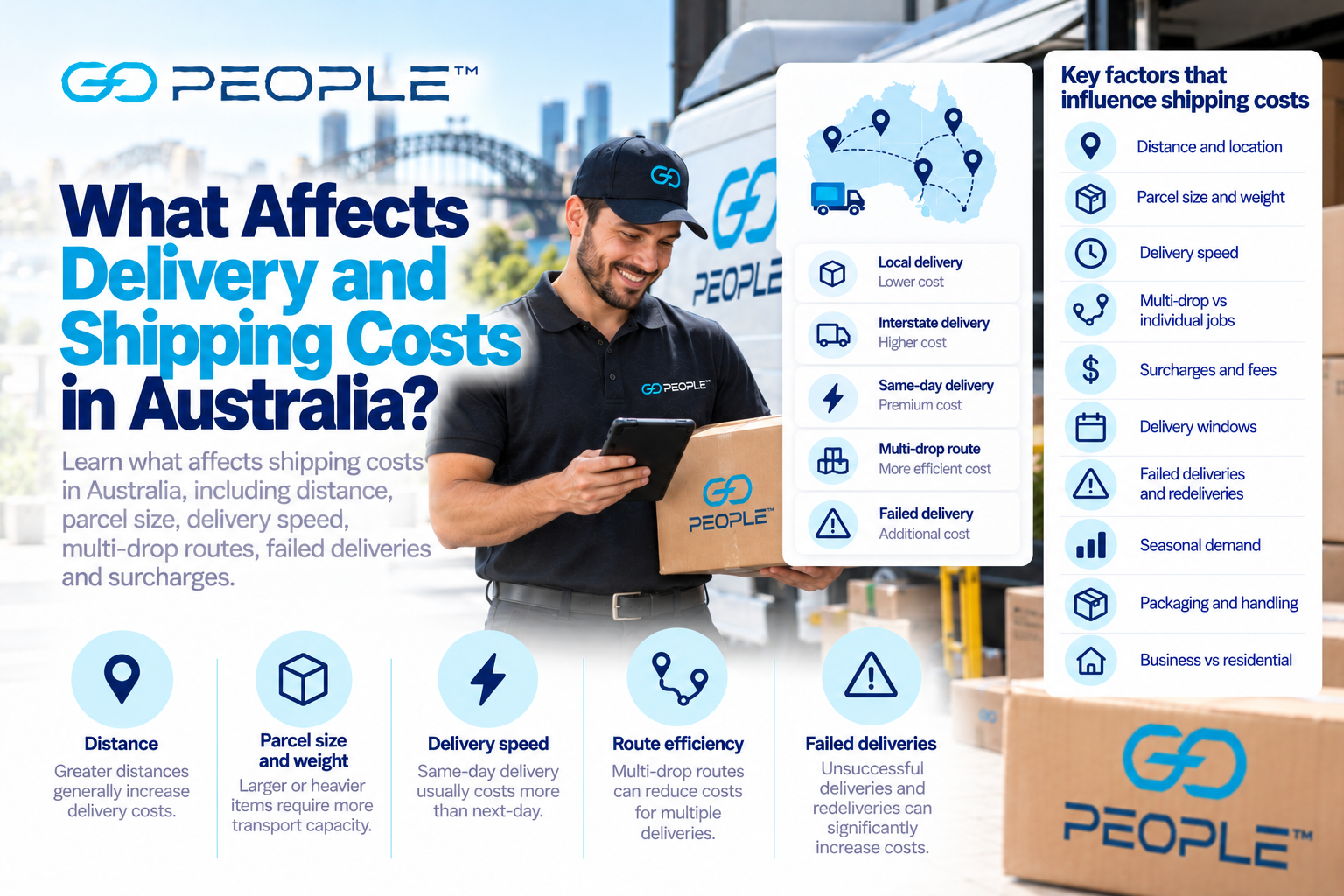
Shipping and delivery costs can vary dramatically between orders.
A small parcel travelling across a metropolitan area may cost very little compared with a bulky item travelling a long distance. An urgent same-day delivery may cost more than a parcel that can arrive tomorrow. A business sending 30 orders from one warehouse may achieve very different economics depending on whether those orders are booked individually or organised into an efficient multi-drop route.
For Australian businesses, understanding what drives delivery costs is important because the cheapest advertised rate does not necessarily produce the lowest total delivery cost.
Distance, parcel characteristics, delivery speed, pickup location, route efficiency, failed deliveries, surcharges and operational processes can all affect what a business ultimately spends.
This guide explains the major factors that influence shipping and delivery costs in Australia — and what businesses should consider when comparing delivery options.
Shipping Cost vs Delivery Cost: Is There a Difference?
The terms shipping and delivery are often used interchangeably, particularly in ecommerce.
In practice, shipping can refer to the broader process of moving an order from the seller through a transport network, while delivery commonly refers to the final movement to the recipient.
From a business perspective, however, the important distinction is between:
the price charged by the delivery provider
and
the total cost of getting an order successfully to the customer.
For example:
Total delivery cost = carrier charge + internal handling + surcharges + failed-delivery costs + redelivery + customer support + other operational costs
That broader view is useful when comparing delivery options.
1. Distance
Distance is one of the most obvious factors affecting delivery cost.
Generally, transporting an item further requires more:
- driving time;
- fuel;
- vehicle capacity;
- labour; and
- network handling.
But delivery pricing is not always calculated as a simple dollar amount per kilometre.
Depending on the provider and service, pricing may instead use:
- delivery zones;
- postcode bands;
- distance ranges;
- metropolitan areas;
- fixed service rates; or
- another pricing structure.
Two destinations that are geographically close may therefore not always have identical delivery prices.
What businesses should do
Understand how the provider defines its delivery area and pricing zones.
If your customers are concentrated in particular areas, analyse your actual order distribution rather than comparing rates using only one example postcode.
2. Pickup Location
Where the delivery begins can matter just as much as where it ends.
For example, businesses may dispatch from:
- warehouses;
- retail stores;
- dark stores;
- offices;
- fulfilment centres;
- 3PL facilities; or
- multiple locations.
Some delivery services have specific pickup areas.
Others may price differently depending on the origin and destination.
This means a business with warehouses in Sydney, Melbourne and Brisbane may have a very different delivery profile from one dispatching every Australian order from a single warehouse.
Consider inventory location
Moving stock closer to customers can sometimes reduce delivery distance, but operating additional fulfilment locations also creates costs.
Businesses should consider the entire fulfilment model rather than delivery pricing in isolation.
3. Parcel Size
Larger parcels consume more vehicle and network capacity.
Ten small satchels and ten large boxes may represent the same number of deliveries, but they do not necessarily require the same transport resources.
Depending on the provider, parcel dimensions may affect:
- pricing;
- vehicle requirements;
- sorting;
- handling; and
- delivery eligibility.
Right-size your packaging
Oversized packaging can increase delivery costs without improving the customer experience.
A small product placed inside an unnecessarily large box may:
- consume more vehicle space;
- require more packaging material;
- increase handling complexity; and
- potentially affect the applicable delivery charge.
Using packaging appropriate to the product can therefore improve both delivery efficiency and material usage.
4. Parcel Weight
Weight can also affect delivery pricing.
Heavier items may require:
- additional handling;
- different vehicles;
- different loading processes; or
- different service categories.
Providers may apply:
- weight bands;
- maximum weights;
- heavy-item charges; or
- different pricing structures.
Businesses should understand whether pricing is based on:
actual weight, dimensions, volumetric weight or another measure.
The answer varies by provider.
5. Volumetric Weight
Some shipping networks consider not only how much a parcel weighs but how much space it occupies.
This is often represented through volumetric or dimensional weight.
The basic principle is simple:
A large lightweight box may consume more transport capacity than a small heavy box.
For example, a box containing a lightweight but bulky product might physically occupy the same vehicle space as several smaller parcels.
Different carriers can use different formulas and divisors, so businesses should check the applicable pricing rules rather than assuming one universal calculation.
6. Delivery Speed
Generally, greater urgency reduces the amount of flexibility available to the delivery operation.
A parcel that must be collected immediately and delivered urgently may require dedicated capacity.
A parcel that can arrive tomorrow provides more opportunity for:
- consolidation;
- sorting;
- route planning;
- capacity management; and
- network efficiency.
That is why delivery speed can significantly influence price.
A useful way to think about delivery options is:
| Requirement | Delivery approach |
|---|---|
| Regular parcel required the following day | Next-day delivery |
| Multiple destinations from one pickup | Multi-drop delivery |
| Order required that day | Same-day delivery |
| Individual urgent job | On-demand courier |
Businesses should avoid paying for urgent delivery when the customer does not actually need it.
At the same time, using a slower service for a genuinely urgent order can create customer-service and operational costs.
The right objective is appropriate speed, not maximum speed.
7. Same-Day vs Next-Day Delivery
Same-day and next-day services solve different problems.
Same-day delivery
Useful when an order genuinely needs to reach the recipient on the same day.
Next-day delivery
Useful for regular business or ecommerce parcels that can be collected, processed through the delivery operation and delivered the following day.
Same-day delivery may require more immediate capacity and tighter routing constraints.
Next-day delivery can provide greater opportunity for consolidation and network planning.
For a detailed comparison, see Same-Day vs Next-Day Delivery: What’s the Difference?.
8. Individual Jobs vs Multi-Drop Delivery
This is an important cost consideration for businesses making many local deliveries.
Imagine a retailer has 30 orders ready at one warehouse.
One approach is:
30 separately booked point-to-point deliveries
Another is:
one pickup + coordinated multi-drop route + 30 destinations
These are operationally different models.
A multi-drop approach can reduce duplicated pickup activity and allow stops to be organised into a more efficient route.
This does not mean multi-drop is always cheaper for every delivery profile.
It means businesses sending many orders from one location should compare the economics of the whole run, rather than automatically treating each parcel as an unrelated courier job.
GoBUNDLE is GoPeople’s multi-drop service for this type of delivery requirement.
9. Route Efficiency
Delivery cost is affected not only by how far the destinations are from the warehouse, but by how efficiently they can be connected.
Consider two groups of 20 deliveries.
Route A
All destinations are concentrated within several nearby suburbs.
Route B
Destinations are widely dispersed across a metropolitan area.
Both routes contain 20 stops.
But Route B may require significantly more:
- kilometres;
- driving time;
- fuel;
- driver time; and
- operational capacity.
This is why delivery density matters.
Route optimisation can help businesses sequence stops more efficiently and reduce unnecessary travel.
For more detail, see Delivery Route Optimisation for Businesses.
10. Delivery Density
Delivery density describes how closely grouped deliveries are geographically.
Higher density can create more efficient delivery economics because a driver may complete more stops with less travel between them.
For example:
20 deliveries across three neighbouring suburbs
may be more efficient than:
20 deliveries scattered across an entire city.
This matters when businesses analyse delivery cost.
A simple average such as:
“We send 50 parcels per day.”
doesn’t tell the full story.
Where those 50 customers are located may significantly affect the cost of serving them.
11. Delivery Windows
Narrow delivery windows reduce routing flexibility.
Suppose ten customers simply require delivery during the day.
The route can potentially be arranged efficiently.
Now suppose each customer requires a different 30-minute window.
The route becomes much more constrained.
Tighter windows may require:
- additional drivers;
- less efficient sequencing;
- more waiting;
- additional route capacity; or
- dedicated delivery resources.
Businesses should therefore consider whether customers genuinely require narrow windows before building them into the service.
12. Failed Deliveries
A failed delivery can turn one delivery cost into several costs.
For example:
Original delivery + support + additional handling + redelivery
Possible causes include:
- incorrect address;
- missing unit number;
- recipient unavailable;
- locked building;
- missing access instructions;
- business closed;
- incorrect contact details; and
- inability to complete the delivery safely.
This is why first-attempt delivery success is an important cost metric.
A provider with a slightly lower initial delivery price may not necessarily be cheaper if unsuccessful deliveries occur more frequently.
For practical strategies, see How to Reduce Failed Deliveries and Improve First-Attempt Delivery Success.
13. Redelivery
When another delivery attempt is required, additional costs may arise.
Depending on the delivery service, the parcel may need to:
- return to a warehouse;
- be processed again;
- be rebooked;
- be allocated to another route; and
- travel to the recipient again.
There may also be additional:
- customer-service time;
- administrative work;
- warehouse handling; and
- delivery charges.
Businesses should ask potential providers how unsuccessful deliveries and redeliveries are priced and managed.
14. Fuel Levies and Surcharges
The advertised base rate may not be the final delivery charge.
Depending on the provider, additional charges can include:
- fuel levies;
- remote-area charges;
- waiting-time charges;
- oversized-item fees;
- redelivery charges;
- after-hours charges;
- peak-period surcharges; or
- other service-specific fees.
Pricing structures vary considerably.
When comparing providers, ask for the complete pricing model, not just a headline rate.
15. Waiting Time
Drivers may lose time waiting at:
- warehouses;
- loading docks;
- retail stores;
- security desks;
- customer premises; and
- congested pickup areas.
For example, if a driver arrives for a scheduled collection but the parcels are not ready for another 30 minutes, that delay consumes delivery capacity.
Depending on the service, waiting may also result in additional charges.
Reduce avoidable waiting
Before collection:
- finish picking;
- finish packing;
- attach labels;
- stage parcels;
- prepare paperwork where required; and
- make sure staff know the pickup is expected.
A well-organised pickup can improve the efficiency of the entire route.
16. Special Handling Requirements
Some goods require more careful or specialised handling.
Examples may include:
- fragile products;
- unusually shaped items;
- high-value goods;
- oversized items; or
- goods with specific transport requirements.
Not every courier or delivery service is suitable for every product.
Special requirements may affect:
- packaging;
- vehicle type;
- handling;
- insurance;
- delivery process; and
- cost.
Businesses should confirm that the provider accepts and can appropriately transport the goods before comparing price.
17. Packaging
Packaging affects cost in several ways.
Poor packaging can:
- increase parcel dimensions;
- create product damage;
- require replacement shipments;
- make loading less efficient; and
- increase material usage.
Appropriate packaging should protect the product without creating unnecessary bulk.
For fragile goods, protection is particularly important.
See How to Pack and Deliver Fragile Items Safely for practical guidance.
18. Delivery Volume
Businesses sending higher delivery volumes may have different pricing arrangements from occasional users.
Volume can affect:
- account pricing;
- negotiated rates;
- operational planning;
- pickup arrangements; and
- service structure.
But higher volume does not automatically guarantee lower total cost.
A business sending 1,000 poorly planned deliveries can still operate inefficiently.
Volume should be considered alongside:
- delivery density;
- parcel profile;
- service type;
- failed-delivery rate; and
- operational efficiency.
19. Seasonal Peaks
Delivery demand can change dramatically during:
- Christmas;
- Black Friday;
- major sales events;
- product launches;
- public holidays; and
- other seasonal peaks.
Higher demand may create:
- capacity constraints;
- longer processing times;
- different service conditions;
- additional staffing requirements; and
- potential peak-period pricing.
Businesses should plan for seasonal delivery demand before the orders arrive.
That includes reviewing:
- warehouse capacity;
- packaging supplies;
- delivery capacity;
- customer cut-offs; and
- delivery expectations.
20. Remote and Regional Deliveries
Delivering to a dense metropolitan area is operationally different from delivering to a distant or low-density location.
Regional and remote deliveries may involve:
- longer distances;
- lower delivery density;
- additional network stages;
- fewer available services; and
- different pricing.
Businesses selling across Australia should therefore avoid assuming that one delivery rate or service applies everywhere.
Check the provider’s actual coverage and pricing rules.
21. Returns
Outbound delivery is only one part of ecommerce logistics.
Returns can add:
- return transport;
- customer support;
- inspection;
- restocking;
- replacement delivery; and
- administrative costs.
For products with high return rates, the cost of reverse logistics can materially affect the economics of fulfilment.
Businesses should consider:
outbound delivery + returns + replacement delivery
when calculating the full cost of serving a customer.
22. Internal Administration
Courier invoices are visible.
Internal administration is less visible.
Consider the staff time spent:
- entering bookings;
- planning routes;
- contacting drivers;
- checking delivery status;
- answering customer enquiries;
- locating proof of delivery;
- processing failed deliveries; and
- reconciling delivery invoices.
A delivery service that reduces manual work may create savings outside the delivery charge itself.
This becomes increasingly important as order volume grows.
23. Technology and Integrations
Delivery technology can affect operational cost.
For example, integrations may reduce the need to manually copy:
- customer names;
- addresses;
- phone numbers;
- order references;
- delivery instructions; and
- parcel information.
Tracking can reduce manual status enquiries.
Route optimisation can reduce unnecessary travel.
Proof of delivery can simplify investigations.
Technology therefore contributes to delivery economics even when it does not directly change the per-parcel rate.
24. Customer Support Costs
When customers cannot understand what is happening with their delivery, they contact the retailer.
Each enquiry has a cost.
Consider a business receiving 100 weekly messages asking:
“Where is my order?”
Even if each enquiry takes only five minutes:
100 × 5 minutes = 500 minutes
That’s more than eight hours of support time every week.
Better tracking and proactive delivery notifications can reduce some of this workload.
Delivery cost should therefore include the customer-service burden created by the delivery experience.
25. Delivery Reliability
A low delivery rate loses some of its appeal if the service regularly creates:
- delays;
- failed deliveries;
- customer complaints;
- investigations;
- redeliveries;
- replacements; or
- refunds.
This is why businesses should compare delivery providers using both:
price
and
performance.
A useful question is:
“What does it cost us when the delivery doesn’t go according to plan?”
That number may be much larger than the courier fee.
What Is the True Cost of a Delivery?
A useful model is:
True delivery cost = provider charges + internal administration + failed delivery costs + redelivery + customer support + replacements/refunds + operational overhead
Not every business needs to calculate every component for every parcel.
But the framework helps when comparing delivery strategies.
Consider two hypothetical services:
| Cost component | Service A | Service B |
|---|---|---|
| Base delivery | $10.00 | $11.00 |
| Average exception/redelivery cost per order | $1.80 | $0.50 |
| Average support/admin cost | $1.20 | $0.60 |
| Indicative total | $13.00 | $12.10 |
These figures are illustrative only.
The point is that the service with the lowest base price is not necessarily the lowest-cost operation.
How Businesses Can Analyse Their Delivery Costs
Start with actual data.
Collect:
- number of deliveries;
- total courier spend;
- service type;
- average parcel size;
- common delivery areas;
- delivery density;
- failed deliveries;
- redeliveries;
- support enquiries;
- refunds or replacements; and
- administrative time.
Then segment the data.
For example:
By service
How much do next-day, same-day and urgent deliveries cost?
By area
Which suburbs or regions are most expensive?
By parcel type
Do bulky products materially increase cost?
By customer type
Do B2B and residential deliveries have different failure rates?
By delivery model
How do individual courier jobs compare with multi-drop routes?
This creates a much better basis for delivery decisions than relying on an average courier charge.
How to Compare Delivery Quotes Properly
When requesting quotes, give providers the same information.
Include:
- pickup postcode;
- delivery areas;
- average daily volume;
- parcel dimensions;
- parcel weight;
- delivery timeframe;
- business/residential mix;
- number of multi-drop deliveries;
- seasonal peaks; and
- any special requirements.
Then ask about:
- base pricing;
- fuel levies;
- surcharges;
- redelivery;
- waiting time;
- parcel limits;
- account fees;
- tracking;
- proof of delivery; and
- support.
Comparing two headline rates without comparing the underlying service can be misleading.
Choosing the Right Delivery Model
Different order types can justify different delivery models.
GoPeople provides several business delivery options:
GoEXPRESS for next-day business delivery.
GoBUNDLE for multi-drop delivery runs.
GoSAMEDAY for same-day business delivery.
GoVIP for urgent on-demand courier requirements.
Rather than choosing one delivery service for every order, businesses can consider the urgency and delivery profile of each shipment.
Service availability varies by service and pickup location, so eligibility should be confirmed before setting customer expectations.
How to Reduce Delivery Costs
Understanding the cost drivers is the first step.
Businesses can then look for opportunities such as:
- right-sizing packaging;
- improving address accuracy;
- reducing failed deliveries;
- consolidating suitable deliveries;
- optimising routes;
- using appropriate delivery speeds;
- reducing manual administration;
- improving integrations;
- preparing parcels before pickup; and
- analysing delivery performance.
We’ve covered these strategies in more detail in How Businesses Can Reduce Delivery Costs Without Sacrificing Service.
Frequently Asked Questions
What affects shipping costs in Australia?
Common factors include distance, pickup and delivery locations, parcel dimensions, weight, delivery speed, route density, delivery windows, surcharges, failed deliveries and special handling requirements. Pricing methods vary between providers.
Does parcel size affect shipping cost?
It can. Larger parcels consume more transport capacity, and some providers use dimensions or volumetric weight when calculating charges. Businesses should check the specific pricing method used by their provider.
Is same-day delivery more expensive than next-day delivery?
Pricing depends on the provider, route and delivery requirements. Same-day delivery generally provides less time for consolidation and planning, while next-day services may have greater operational flexibility. Businesses should compare actual quotes for their delivery profile.
How can businesses reduce delivery costs?
Opportunities can include right-sizing packaging, improving address quality, reducing failed deliveries, consolidating suitable deliveries, optimising multi-drop routes, choosing appropriate delivery speeds and reducing manual administration.
Why do failed deliveries increase shipping costs?
A failed delivery can require additional handling, customer support, redelivery or return processing. This means the total cost can be significantly higher than the original delivery charge.
What is volumetric weight?
Volumetric weight is a way of considering the amount of space a parcel occupies rather than only its physical weight. Formulas vary between carriers, so businesses should check the applicable provider’s calculation.
Should businesses choose the courier with the cheapest rate?
Not necessarily. Compare the complete service, including surcharges, tracking, proof of delivery, failed-delivery processes, support and operational workload. The lowest base rate does not always produce the lowest total delivery cost.